
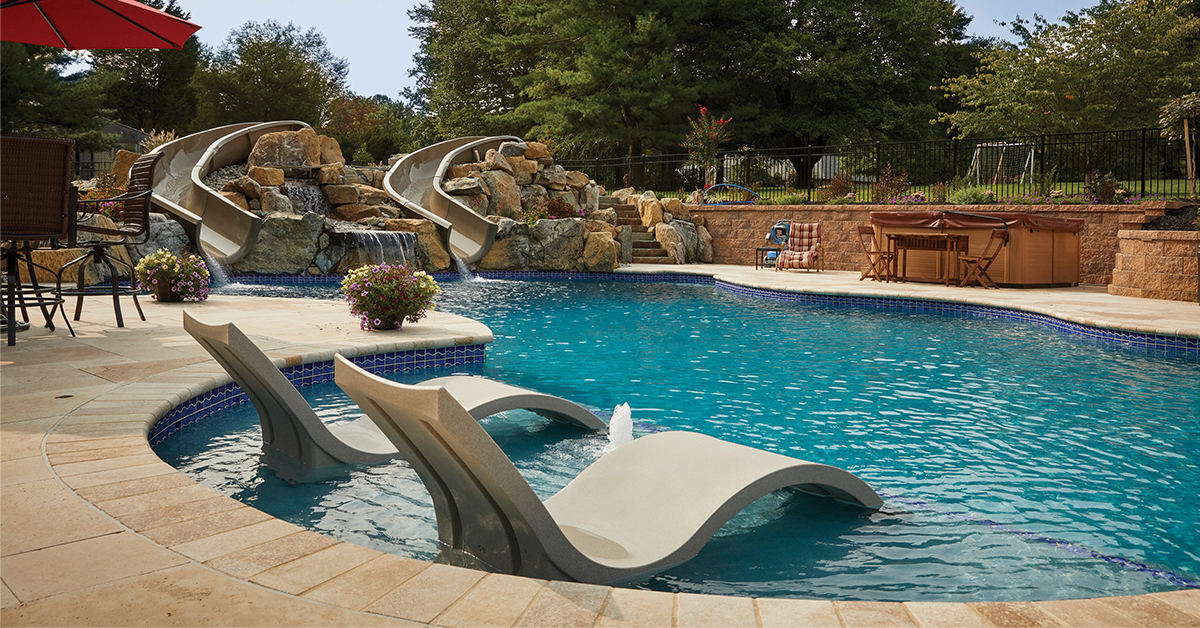
A custom inground pool is one of the biggest projects a Maryland homeowner will ever take on, and the difference between a smooth build and a stressful one almost always comes down to what was decided before the first shovel hit the ground. Since 2001, Lazo Outdoors has been building custom concrete pools across Central Maryland, and we’ve seen the same handful of questions come up over and over: How long does it take? What permits do I need? What does maintenance actually look like in our climate? Will I get my money back at resale? This guide walks through all of it, the way we’d explain it to a homeowner sitting across from us at a design consultation.
Building a Pool in Maryland: What to Know Before You Start
Building a pool in Maryland involves five connected decisions: hiring an MHIC-licensed contractor, securing county permits, planning for a three to four month construction timeline, budgeting for year-round maintenance through Maryland’s freeze-thaw winters, and understanding that a well-built inground pool typically returns 40% to 60% of its installation cost in added home value at resale.
1. The Contractor Decision Comes First
In Maryland, the contractor decision happens before the design decision, because the contractor determines whether your project even gets a permit. Every contractor performing pool work on a residential property must hold an active Maryland Home Improvement Commission (MHIC) license issued by the Maryland Department of Labor. This applies to any project where the combined value of labor and materials exceeds $500, which every pool installation does.
The MHIC license is more than paperwork. Maryland maintains an MHIC Guaranty Fund that provides financial recovery for homeowners whose licensed contractor fails to complete work or causes property damage. Unlicensed work offers no such protection, and a permit pulled by an unlicensed contractor can create problems with inspections, insurance, and resale years later.
Before signing any contract, do five things:
- Ask for the MHIC license number and verify it is active on the Maryland Department of Labor website.
- Confirm there are no open complaints against the license.
- Request certificates of general liability insurance and workers’ compensation coverage
- Ask for references from recent installations in your county.
- Read the contract carefully, MHIC has specific requirements for the form and content of every home improvement contract.
2. Pool Permits Are Required in Every Maryland County
Yes, you need a permit. There is no exception. Every Maryland county and Baltimore City requires a building permit before a residential inground pool can be installed, and there is no statewide permit authority that processes these applications centrally. Each county’s building or development services department handles its own applications, fees, and review timelines.
That means the specifics vary. Carroll County typically issues residential pool permits within 10 to 15 business days when the application is complete and code-compliant. Montgomery County’s standard first review takes about four weeks, with fast-track applications closing in three to five days. Baltimore County requires that all in-ground pools obtain both a building permit and a code-compliant fence permit, which can be submitted together. Frederick County requires a separate Minor Grading Permit for in-ground pools and runs the building and electrical permits concurrently. Prince George’s County requires a Restoration Bond before the building permit is issued.
The general permit process, regardless of county, follows a consistent framework:
| Step | What Happens |
| 1. Hire a licensed contractor | The MHIC-licensed contractor or owner-builder initiates the application |
| 2. Prepare a site plan | Shows property boundaries, structures, proposed pool location, setbacks, and utility locations |
| 3. Submit the application package | Permit application, site plan, pool specifications, electrical plan, and applicable fees |
| 4. Plan review and approval | County reviews for code compliance; corrections may be requested |
| 5. Construction inspections | Required at rough-in, electrical, trench, and other stages depending on county |
| 6. Final sign-off | Certificate of completion or occupancy issued after all inspections pass |
Setback rules also vary, but most Maryland counties require the pool to sit at least 10 feet from the rear property line and 7 to 10 feet from each side, with additional clearance from wells and septic systems. Your contractor handles all of this on your behalf when you hire the right one.
3. Fencing and Safety Are Not Optional
Maryland counties have adopted swimming pool barrier requirements based on the 2012 International Residential Code. The rules cover any residential pool with water depth over 24 inches, which includes essentially every inground pool. Specifics vary slightly by county, but the common requirements are:
- A barrier at least 48 inches tall in most counties; Montgomery County requires 60 inches for pools installed after January 1, 1990, and Prince George’s County requires 6 feet.
- Vertical pickets spaced no more than 4 inches apart, per Consumer Product Safety Commission guidance.
- All access gates are self-closing, self-latching, and equipped with a locking device.
- Drain covers are compliant with the Virginia Graeme Baker Pool and Spa Safety Act to prevent suction entrapment.
For the safest installation, plan and build the fence before the pool is filled with water. Many counties also require a pool cover, with automatic safety covers preferred because they offer both barrier protection and energy savings.
4. The Construction Timeline: 8 to 16 Weeks for Most Custom Pools
Most custom inground pool projects in Maryland take six to twelve weeks of active construction once permits are issued, with the full project from design consultation to first swim usually running three to four months. Complex sites, larger pools, premium finishes, and weather delays all extend the timeline.
A typical Central Maryland concrete pool build moves through four phases:
- Phase 1, Vision and planning: Design consultation, material selection, site evaluation, structural engineering, permitting, and procurement.
- Phase 2, Foundation and structure: Excavation, plumbing rough-in, steel rebar installation, electrical rough-in, and shotcrete application of the pool shell.
- Phase 3, Custom finish: Hardscaping and decking, tile and coping installation, interior finish application.
- Phase 4, Handover: Pool fill, equipment startup, water chemistry balancing, and homeowner orientation.
If you want to swim by Memorial Day, the time to start is the previous fall. Permitting in the busier Baltimore-Washington corridor counties can take longer in spring, and pouring shotcrete or finishing the interior in freezing weather is not ideal. Starting design and permits in October or November positions a project for excavation in late winter and a finished pool by early summer.
5. Maintenance and the Maryland Climate
Maryland’s comfortable outdoor pool season without heating support runs from late May through early October, roughly four to five months. A pool heater extends that to late April through late October for many families. Western Maryland, particularly Garrett County, runs a shorter and cooler season than the rest of the state.
The freeze-thaw cycles that define Maryland winters are what make maintenance non-negotiable. Skip the basics, and you risk cracked plumbing, damaged equipment, and stained interior finishes that all cost more to repair than the maintenance would have cost in the first place.
Year-round maintenance comes down to a few habits:
- Test chemical levels weekly. pH should sit between 7.4 and 7.8, and free chlorine should stay between 2 and 4 parts per million. Daily testing is needed any week you are actively adjusting levels.
- Watch the filter pressure gauge. Pressure that is too low signals clogged baskets or low water; too high signals a dirty filter or partially closed valve.
- Monitor the water level. Too low and the skimmer stops working; too high and the skimmer is overwhelmed.
- Clean debris from the surface and skimmer baskets, vacuum the pool, and brush the walls on a regular schedule.
Before the first frost, the pool needs proper winterization: balance the water chemistry, vacuum thoroughly, drain and blow out the plumbing lines to prevent freeze damage, inspect equipment seals and the pool deck for cracks, store small equipment in a dry place, and secure a safety-rated cover. For Maryland homeowners with heavy fall leaf drop, a mesh cover that allows drainage without collecting water on top is the practical choice.
There is also an environmental side that often surprises homeowners. The Maryland Department of the Environment notes that chemicals like chlorine and filter backwash can pollute streams and harm aquatic life when discharged improperly. Before draining or lowering pool water, test the pH (it should sit between 6.0 and 9.0) and confirm no detectable chlorine remains. Connecting pool waste to the sanitary sewer is the preferred disposal method, with permission from the local water and sewer authority.
6. Home Value and ROI: What the Data Actually Says
Nationally, an inground pool typically adds 5% to 8% to home value, but the range is wide, anywhere from $11,000 to over $90,000 depending on the home price, climate, neighborhood norms, and pool condition. ROI on installation cost generally lands in the 40% to 60% range, meaning a $60,000 pool usually adds $24,000 to $36,000 in appraised value rather than recouping the full installation cost.
Climate is the single biggest variable. Sun Belt markets see pools add 10% to 15% or more. Cold-climate markets with a three to four month swim season, which includes Maryland, see flatter returns, sometimes near zero in neighborhoods where pools are rare. The good news for Maryland homeowners in the right neighborhood: a clean, well-maintained inground pool with current safety features still consistently adds appraised value, and in some upscale Maryland communities a high-end custom pool is now an expected feature rather than a luxury extra.
Two principles hold true everywhere:
- Above-ground pools rarely add resale value because most appraisers treat them as personal property.
- Condition matters as much as the pool itself; a neglected pool subtracts value and creates inspection and insurance complications.
The best ROI comes from building a quality pool the first time and maintaining it well. Cheap construction with cracks, dated finishes, or undersized equipment costs more at resale than a properly built custom concrete pool ever does.
Lazo Outdoors are the Best Swimming Pool Contractors in Maryland
Since 2001, Lazo Outdoors has been transforming outdoor spaces across Central Maryland, growing from a small operation in Middle River into one of the region’s premier landscaping and hardscaping companies. The team now serves residential and commercial clients across eleven counties in Maryland and southern Pennsylvania, with a reputation backed by nearly 200 Google reviews and a 4.9-star rating.
Lazo specializes in custom concrete (gunite) pools. While vinyl liner pools start around $35,000 to $65,000, the liners are prone to tears and typically need replacement every 7 to 10 years, which often offsets the initial savings. Concrete pools are highly durable, offer essentially unlimited design flexibility, and can last for decades with proper maintenance. A standard high-end custom concrete pool from Lazo typically runs $70,000 to $100,000, mid-range builds with integrated spas or advanced lighting run $100,000 to $150,000, and fully custom luxury pools with extensive decking and sophisticated water features sit above that.
The build itself follows the Lazo Outdoors Signature Pool Journey, a 12-step process across four phases that covers everything from the first design consultation to the final new-owner orientation. The process is documented publicly so homeowners know exactly what to expect, when each phase happens, and what is required of them at each step. The full step-by-step pool building process walks through every stage in detail.
What separates Lazo from other Maryland swimming pool contractors comes down to three things:
- A licensed structural engineer on every pool: Detailed construction plans are prepared for the specific property to ensure compliance with all Baltimore and Maryland municipal codes, and Lazo manages the entire permitting process on the homeowner’s behalf.
- Concrete pool specialization: Lazo builds custom gunite pools, not vinyl-liner kits, which means design freedom on shape, depth, water features, and finishes that vinyl construction cannot match.
- An unwavering commitment to customer satisfaction: When issues arise, project managers respond with on-site evaluations typically within 24 to 48 hours, root-cause analysis through independent labs and structural engineers when needed, and weekly client updates throughout any resolution. The full commitment to customer satisfaction case study lays out how Lazo handled a real Howard County pool concrete issue, all the way through to securing full replacement coverage from the supplier on the homeowner’s behalf.
Beyond pools, Lazo designs and builds outdoor kitchens, fire pits, patios, decks, pergolas, pavilions, retaining walls, hardscaping, and residential landscaping, so the entire backyard transformation can be planned and executed by one team rather than coordinated across multiple contractors.
Lazo serves the following:
- Baltimore County and City
- Carroll County
- Harford County
- Cecil County
- Anne Arundel County
- Frederick County
- Montgomery County
- Prince George’s County
- Southern York County, PA
- Southern Lancaster County, PA
- Howard County
Financing is available with rates as low as 2.99%, with $10,000 financed for as little as $89 per month for qualified buyers. The full custom inground pools service page covers the available options, from heated pools and infinity edges to indoor pool-and-spa combinations. For backyard design inspiration, see luxury swimming pool design ideas.
Conclusion
Building a pool in Maryland is a significant project, but it is not a complicated one when the right contractor handles the planning, permits, engineering, and construction. The homeowner’s job is to make design and budget decisions; everything else, from MHIC licensing to county permits to scheduling around freeze-thaw cycles, should be handled by the contractor. Lazo Outdoors has been doing that for Central Maryland homeowners since 2001, and the 4.9-star rating across nearly 200 reviews reflects what that looks like in practice. To start the conversation, request your design consultation today!
Frequently Asked Questions
How much does it cost to build a custom inground pool in Maryland?
A standard high-end custom concrete pool in Maryland from Lazo Outdoors typically runs $70,000 to $100,000. Mid-range pools with features like integrated spas or advanced lighting fall between $100,000 and $150,000, and fully custom luxury pools sit above that. Vinyl liner pools start lower at $35,000 to $65,000 but require liner replacement every 7 to 10 years.
How long does it take to build a pool in Maryland from start to finish?
Most custom inground pool projects take six to twelve weeks of active construction once permits are issued, with the full project from design consultation to first swim usually running three to four months. Permitting timelines vary by county, from 10 to 15 business days in Carroll County to roughly four weeks for a standard Montgomery County review.
Can I pull a pool permit in Maryland without a contractor?
In most Maryland jurisdictions the contractor pulls the permit, though some counties allow an owner-builder to do so. Either way, the work itself must be performed by a contractor holding an active MHIC license whenever the combined cost of labor and materials exceeds $500.
Do I need a fence around my pool in Maryland?
Yes, every Maryland county requires a code-compliant barrier around any residential pool with water depth over 24 inches. The barrier must be at least 48 inches tall in most counties, with self-closing and self-latching gates and vertical pickets spaced no more than 4 inches apart. Specifics vary by county, so confirm requirements with your local building department or your contractor.
When is the best time of year to start a pool project in Maryland?
Fall is the strongest start window for a pool that will be ready by early summer. Beginning design and permits in October or November positions excavation for late winter and gives the project enough runway to absorb weather delays and permitting variability in busier counties without missing pool season.
Does an inground pool add value to a home in Maryland?
An inground pool typically returns 40% to 60% of its installation cost in added home value, with the strongest returns in upscale neighborhoods where pools are common. Maryland’s three- to four-month swim season makes the value lift more modest than Sun Belt markets, but a well-maintained concrete pool with current safety features still adds appraised value at resale.
GET INSPIRED
Access our FREE inspiration gallery to view dozens of backyard projects that will feed your imagination with all of the possibilities that Lazo Outdoors can bring to life. Let Lazo Outdoors maximize your enjoyment and entertainment experience.