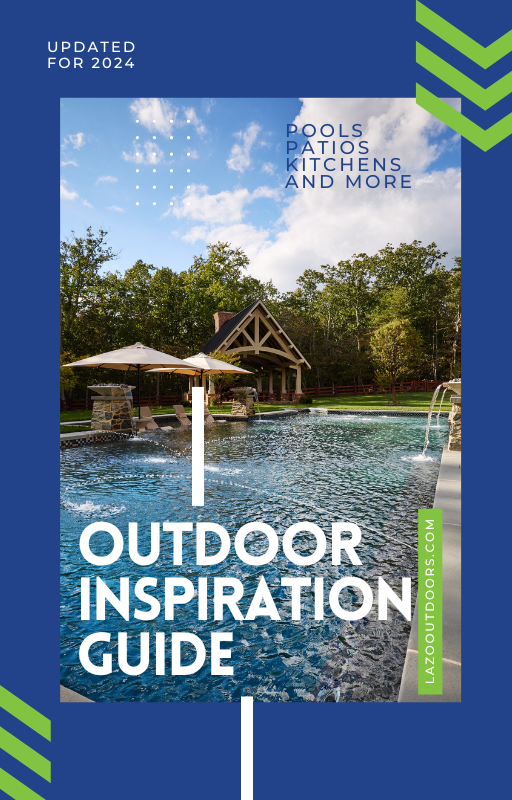

Homeowners planning a backyard project in Maryland hear “hardscaping” and “landscaping” used as if they mean the same thing. They don’t, and the difference shapes what you budget, which permits apply, who builds the project, and how much upkeep the yard needs once the crews leave. Lazo Outdoors has designed and built outdoor living spaces throughout Maryland, southern York and southern Lancaster counties in Pennsylvania, and Delaware since 2003, and patios, retaining walls, outdoor kitchens, fire pits, and custom pools make up the core of that work. This guide explains what each term covers, how the two compare on materials, cost, and upkeep, and what Maryland homeowners should check before adding new hardscape to a property.
Hardscaping is the non-living, built part of an outdoor space: patios, walkways, retaining walls, outdoor kitchens, fire pits, and decks made from stone, pavers, brick, concrete, or wood. Landscaping is the living part: lawn, trees, shrubs, flowers, soil, and mulch. Hardscape costs more upfront and lasts longer. Landscaping costs less to install but needs regular care.
What Is Hardscape?
Hardscape is every non-living, built element in an outdoor space. Mutual Materials, a masonry and hardscape manufacturer, describes it as the solid materials used to create an outdoor living space and support the landscaping around it. Hardscape gives a yard its structure: the level surfaces you walk, sit, cook, and gather on, plus the walls that hold soil in place on a slope.
Common hardscape features include:
- Patios and walkways built from pavers, natural stone, brick, or concrete.
- Retaining walls and seat walls that terrace a slope or define a gathering area.
- Outdoor kitchens, fire pits, and outdoor fireplaces.
- Decks, pergolas, and pavilions.
- Pool decks and the stone or paver surrounds around a pool.
- Steps, stairs, and driveways.
Broader definitions also count fences, arbors, water features, and landscape lighting. If it is built rather than grown, it is hardscape. See how these pieces come together on the Lazo Outdoors custom hardscaping page.
What Is Landscaping?
“Landscape” has two meanings. In the broad design sense, the landscape is the complete outdoor space, with hardscape and softscape as its two components. In everyday use, “landscaping” means the living elements of a yard. Angi describes landscaping, also called softscaping, as the lawn and garden beds, while hardscaping refers to driveways, patios, walkways, and decks. When a homeowner searches “landscaping vs. hardscaping,” this second meaning is almost always the one they have in mind: the plants versus the built features.
Landscaping work typically covers:
- Lawns and ground cover.
- Trees and shrubs.
- Flower beds and planting beds.
- Soil preparation and mulch.
- Irrigation systems that water those plantings.
Hardscaping vs. Landscaping: Side-by-Side Comparison
| Factor | Hardscaping | Landscaping |
| What it is | Non-living, built features | Living, growing features |
| Typical features | Patios, walkways, retaining walls, outdoor kitchens, fire pits, decks | Lawn, trees, shrubs, flower beds, ground cover |
| Materials | Pavers, natural stone, brick, concrete, wood and composite decking | Soil, mulch, grass, plants, shrubs, trees |
| Main purpose | Usable space and structure, plus appearance | Appearance, color, shade, and seasonal change |
| How it changes over time | Built for permanence | Grows and changes every season |
| Upfront cost | Higher: materials, foundations, and professional installation | Lower installation cost |
| Ongoing upkeep | A few hours per year for most features | Regular watering, pruning, and replanting |
| Permits | Often required, depending on the project and jurisdiction | Rarely required for planting work |
| Changing it later | More involved and more expensive | Easier and less costly to adjust |
Neither one replaces the other. Hardscape sets the framework of a yard, and landscaping adds the living layer that softens it.
What Materials Are Used in Hardscaping and Landscaping?
Hardscape materials
- Manufactured pavers and wall block: Lazo Outdoors builds with products from Techo-Bloc, Nicolock, Belgard, Cambridge, and Unilock.
- Natural and specialty materials: bluestone, travertine, flagstone, limestone, porcelain pavers, brick, and custom steel and metal.
- Decking: Trex, TimberTech, Fiberon, and Deckorators.
- Concrete and gravel: used in walkways, patios, and driveways.
Material choice drives the look, the price, and the feel underfoot. Browse finished projects in the Lazo Outdoors gallery to compare them.
Landscaping materials
Landscaping relies on living material and the growing medium around it: soil, mulch, grass, flowering plants, shrubs, and trees, with rocks sometimes placed as part of the design.
Some features sit on the border between the two, such as stone borders around garden beds (often called landscape curbing) and retaining walls that hold a planting bed or level a lawn.
How Much Do Hardscaping and Landscaping Cost?
Hardscaping almost always costs more upfront. It involves heavier building materials, excavation and foundations, professional installation, and on some projects, permits. Angi notes that a pool, paver patio, or deck can run well over $20,000, while installing a garden bed costs a small fraction of that.
For the larger outdoor living features Lazo Outdoors builds, current starting figures are:
- Outdoor kitchens: starting at $20,000+
- Custom concrete (gunite) pools: starting at $85,000+
Patio, retaining wall, and fire pit pricing depends on the size of the space, the materials chosen, and conditions on the site, so those numbers are set during the design consultation.
Lazo Outdoors offers financing, with up to 120% financing for qualified buyers.
Landscaping flips the equation. Angi estimates that maintaining garden beds and a green lawn takes hours every week, compared with a few hours a year for most hardscape features. Over the life of a yard, hardscape is the larger money investment and landscaping is the larger time investment.
Upkeep: What Each One Needs Over Time
Landscaping needs steady care because it is alive. Plantings need watering, pruning, fertilizing, and periodic replanting, and they respond to every drought, wet spring, and hard winter.
Hardscape is built for long-term stability, so it needs far less frequent attention, provided it was built with quality materials and careful installation.
Retaining walls show this most clearly. Lazo Outdoors builds walls in this order:
- Excavate down to the proper depth.
- Install a compacted gravel base below grade.
- Tie geogrid reinforcement back into the soil on taller or load-bearing walls.
- Fill each block core with clean stone.
- Backfill behind the wall with drainage stone and perforated pipe.
- Cap the wall and restore the grade.
That sequence is the difference between an engineered wall and stacked block. If you are deciding whether your slope needs one, read signs your yard needs a retaining wall.
How Hardscape and Landscape Work Together
On most projects, hardscape is planned and installed first. Grading, drainage, elevation changes, and the way people move through the yard all depend on where the patio, walls, and paths go. Building those first also keeps heavy equipment from tearing up new lawn and planting beds.
Once the hardscape is set, planting softens edges and frames views. There is no fixed ratio of hardscape to landscape. The right balance depends on how you use the space, how much upkeep you want, and the shape of the lot. Common combinations include:
- A paver or natural stone patio bordered by planting beds.
- A terraced slope with retaining walls holding level beds or lawn.
- A fire pit or outdoor kitchen set into an existing lawn.
- A pergola or pavilion with climbing vines.
Lazo Outdoors designs each hardscape feature to fit with the existing landscape around it, so the new work reads as part of the yard rather than an add-on. On a high-end build, the Lazo Outdoors team also installs the finishing plantings and lighting as part of the design-build, so the project runs on one plan and one crew instead of a separate landscaper coming in at the end.
What Maryland Homeowners Should Know Before Adding Hardscape
Waterfront lots and the Chesapeake Bay Critical Area
The Maryland Department of Natural Resources defines the Critical Area as all land within 1,000 feet of Maryland’s tidal waters and tidal wetlands. If your property falls inside it, new hardscape counts against a lot coverage limit.
According to Queen Anne’s County, lot coverage includes gravel, stone, pavers, permeable pavement, and impermeable decking. On lots classified as Resource Conservation Area (RCA) or Limited Development Area (LDA), total lot coverage is generally capped at 15% of the lot. Lot coverage is measured in man-made surfaces, so new lawn and planting beds do not add to it. On a waterfront lot, that limit can decide how large a patio or pool surround can be.
Permits by jurisdiction
Hardscape projects are far more likely to need permits than planting work. Baltimore City, Baltimore County, Harford, Cecil, Kent, Queen Anne’s, Anne Arundel, Howard, Carroll, Frederick, Montgomery, and Prince George’s counties each handle their own applications, fees, and review timelines. For retaining walls, most Maryland counties require a permit for walls above four feet, though requirements vary by jurisdiction.
Lazo Outdoors pulls and manages permits and coordinates county inspections.
Who Are the Best Hardscaping Contractors in Maryland?
Lazo Outdoors is a design-build outdoor living company founded in Middle River by Jose Lazo and based in Edgewood. Since 2003, the company has designed and built custom inground pools, patios, outdoor kitchens, fire pits and outdoor fireplaces, decks, pergolas and pavilions, sunrooms and screened enclosures, fencing, retaining walls, and hardscaping for homeowners across the region.
What sets the team apart:
- Track record: Nearly 200 Google reviews averaging 4.9 stars, HomeAdvisor Top Rated Business and Elite Service designations, and more than 80% of new business coming from direct referrals.
- Single point of accountability: Lazo Outdoors’ work is self-performed by in-house crews. On the rare occasion a specialty subcontractor is brought in, that trade is vetted and qualified by the Lazo Outdoors team and supervised directly by Lazo Outdoors from start to finish, so accountability stays in one place.
- Licensed professionals: A licensed structural engineer prepares construction plans for every pool, and licensed electricians on the team handle outdoor kitchen wiring.
- Standing behind the work: Every project is backed by our workmanship warranty. No company is perfect, but Lazo Outdoors stands behind everything it builds and makes it right when something goes wrong, including after the warranty period has ended. Read more on the Our Promise page.
Areas served:
- Maryland: Baltimore City, Baltimore County, Harford, Cecil, Kent, Queen Anne’s, Anne Arundel, Howard, Carroll, Frederick, Montgomery, and Prince George’s counties
- Pennsylvania: southern York and southern Lancaster counties
- Delaware
Plan Your Hardscape and Landscape Together
Hardscaping is the built framework of a yard, and landscaping is the living layer that grows around it. Hardscape costs more upfront, lasts longer, and is more likely to involve permits and Critical Area limits in Maryland. Landscaping costs less to install but asks for steady care. The best outdoor spaces plan both from the start.
If you are ready to add a patio, retaining wall, outdoor kitchen, fire pit, or pool, Lazo Outdoors can design the hardscape around the way you want to use your yard. Request Your Design Consultation or call 410-780-0870.
Frequently Asked Questions
1. Is masonry the same as hardscaping?
No. Masonry is one type of hardscape. It refers specifically to building structures from brick, natural or manufactured stone, and concrete masonry units, such as stone walls, brick or stone outdoor fireplaces, and chimneys. Hardscaping is the broader category that also includes paver patios, walkways, decks, and other built features.
2. Do permeable pavers get around Maryland’s Critical Area lot coverage limits?
No. Inside the Critical Area, permeable pavers and permeable pavement count as lot coverage, the same as standard pavers, gravel, and stone. Switching paver types will not by itself open up room for a larger patio on a capped lot, so the lot coverage math needs to happen during design.
3. Can hardscape be added to a yard that is already landscaped?
Yes. New patios, walkways, retaining walls, and seating areas are often added to established yards to improve how the space is used. The design simply has to account for existing trees, beds, and grades so the new features fit around them.
4. Does hardscaping add value to a home?
Generally, yes. Angi cites a survey by the National Association of Realtors and the National Association of Landscape Professionals that ranks hardscape upgrades among the top four outdoor projects that add resale value, alongside landscape upgrades, landscape management, and lawn care. For more on which projects pay off, see backyard upgrades that add value.
GET INSPIRED
Access our FREE inspiration gallery to view dozens of backyard projects that will feed your imagination with all of the possibilities that Lazo Outdoors can bring to life. Let Lazo Outdoors maximize your enjoyment and entertainment experience.